A New Era Dawns for CNC Factories—Price Is No Longer the Core Battleground
In the past, CNC factories competed for orders by offering low unit prices and flexible minimum order quantities. They readily accepted bulk orders but marked up costs for small batches. Unaltered drawings were ideal; revisions meant rework charges. Yet this business model no longer works for emerging sectors such as drones, energy storage, and humanoid robots.
Why has the old approach failed? When clients from these emerging industries source machining services, their first question is rarely “How much per piece?” Instead, they ask: “How fast can you deliver prototypes?”, “What’s the most complex component you’ve ever machined?”, and “Will you charge extra for drawing revisions?” Unit price takes a backseat—what truly matters is whether manufacturers can keep pace with their development timeline.
Parts for traditional industries follow a steady pattern: a single bracket might run tens of thousands of units annually, with drawing specifications unchanged for three years. Emerging industries operate in stark contrast. A motor base may only require 20 pieces for a trial run, with drawing iterations scheduled the following month. Clients prioritize collaboration over low costs. Can you accommodate drawing modifications without pushback? Can you finish prototypes within three days for their performance testing? Can you flag flawed design details and propose process improvements when they only supply raw blueprints with no established machining workflow?

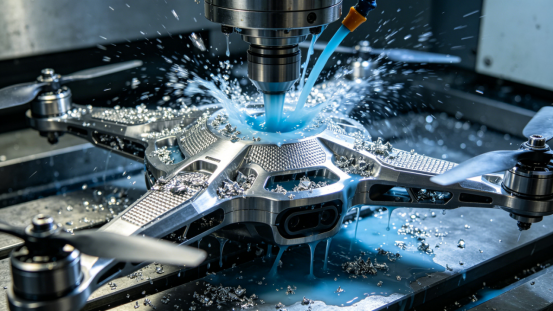
Here is a real-world example. An industrial drone manufacturer approached us to machine gimbal brackets. Though compact in size, the parts required 5-axis machining, with positional tolerance held to ±0.01 mm for multiple bearing bores. We produced five initial prototype units. After testing, the client requested adjustments to two bore positions and the contour of a weight-reduction groove. We machined another five revised samples, followed by a third round tweaking stiffener thickness—four prototype iterations in total. The quoted unit price barely covered our 5-axis labor hours. The client felt guilty and offered to pay surcharges, but we declined, explaining design tweaks are standard during product validation. Once they secured mass-production contracts post-finalization, they awarded the full volume order exclusively to us.
This case proves a vital truth: emerging industries reward proactive pre-production collaboration far more than rock-bottom pricing. Solid upfront partnership locks in long-term mass orders. Undercutting prices alone cannot win business; consistent technical support and cooperative attitude build lasting partnerships.
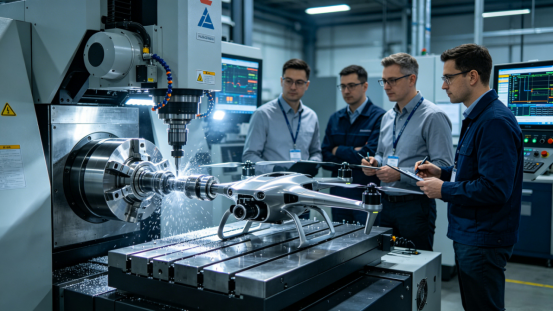
Accordingly, we have overhauled our order acceptance process for emerging-industry components. We waive extra fees for prototyping and drawing revisions, and execute small-batch runs with the same rigorous standards as large orders. Upon receiving your drawings, we first conduct a full manufacturability assessment. If feasible, we provide a transparent, fair quote free of inflated markups for low volumes. If unworkable, we clearly outline bottlenecks to save your time. This is no charitable gesture—it is a calculated business strategy. Eight out of ten emerging-industry clients undergo multiple design iterations before mass production, and the subsequent high-volume orders easily offset all upfront prototyping expenses.
Do you have components for emerging industries requiring CNC machining? Send over your drawings. Regardless of batch size, we first discuss process feasibility before issuing quotations. We move forward if terms align; if not, we will not occupy your valuable time unnecessarily.